Submit when the Science is Done
Learn how to make agentic AI trustworthy in clinical trials, with your experts in control, always.

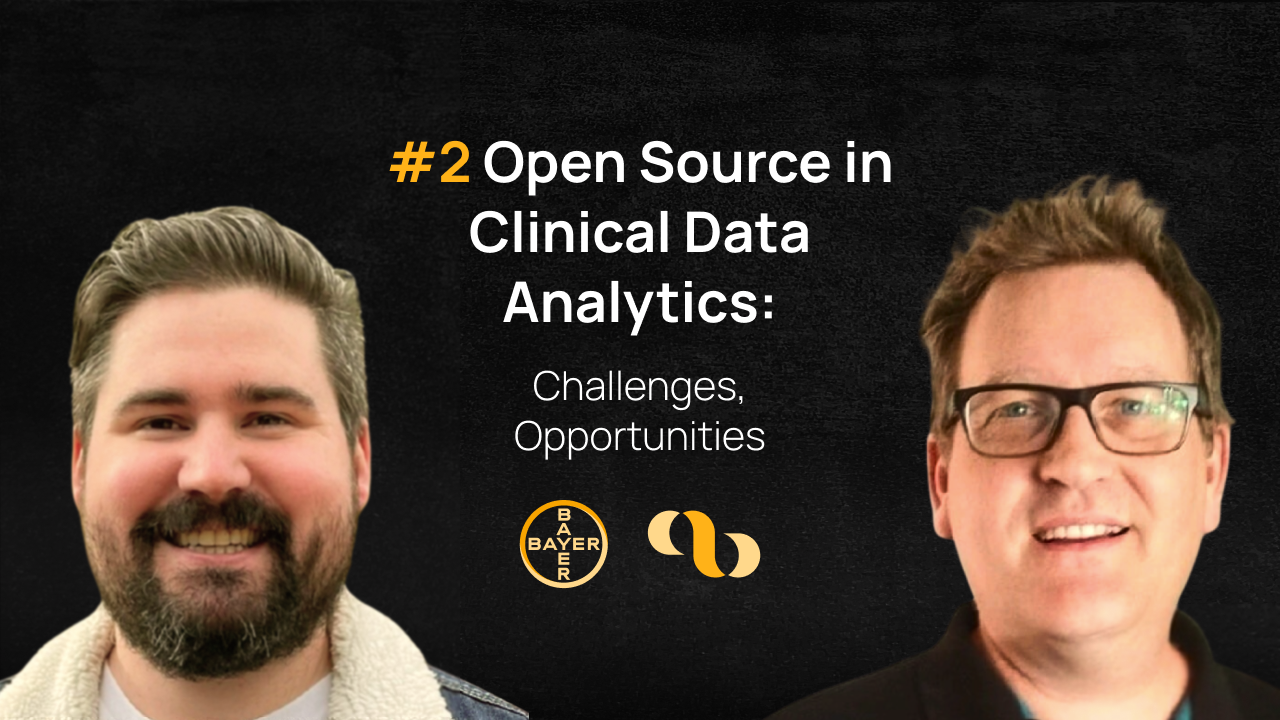
In this episode of the Verisian Community Podcast, Kyle (Syneos) and Oliver (Bayer) discuss the challenges and opportunities of open source in clinical analysis. They look at the importance of people and communication within the industry and the need for a culture change before embracing new systems. They also explore the potential of AI in clinical analysis, highlighting its benefits in code generation and documentation. They agree the need for validation and trust in AI systems and the importance of human expertise in tying everything together.
Guests: Oliver Wirtz, statistical programmer at Bayer working in analysis standards and reporting quality, in the industry since 2001 (starting as a clinical research associate, then data manager, then statistical programmer); Kyle Ireton, statistical programmer at Syneos Health.
Host: Tomás Sabat Stöfsel, CEO & Co-Founder, Verisian
Topics: Guest backgrounds and paths into clinical programming, opportunities and challenges of open source in clinical reporting, the real SAS-vs-R debate (process and infrastructure, not just syntax), building regulatory trust in open-source submissions, recent FDA submissions using open source (Novo Nordisk, Roche), generative AI's realistic near-term applications, metadata-driven documentation, project management as a prerequisite skill.
The full episode can be found on YouTube, Apple Podcasts or Spotify.
Oliver Wirtz has been in the industry since 2001, starting as a clinical research associate traveling to sites to check paper CRFs before the shift to electronic CRFs, then moving into data management, and eventually learning SAS to become a statistical programmer, first at a smaller pharma company and now at Bayer, where he works on analysis standards and reporting quality. Kyle Ireton's route is far newer and less conventional: a neuroscience PhD from UC Davis (2015–2020), a preclinical data-science postdoc, then a stint at a Bay Area medical device startup before joining Syneos the previous December, where he learned SAS essentially in one year while delivering full statistical programming pipelines from SDTM to TLGs, alongside early involvement in R-based projects. The two frame their perspectives as intentionally complementary: Oliver's multi-decade view of how the industry's processes evolved, and Kyle's outsider's-eye view of what looks unusual about those processes to someone who arrived recently.
Asked to weigh open source's opportunities against its challenges, Oliver frames the upside narrowly: using R when a statistical procedure isn't available in your current platform, or letting a new graduate who already knows R start productive work immediately. The challenges, in his view, are almost entirely organizational: running more than one platform doubles validation and maintenance work, requires processes that let both languages coexist, and demands that programmers be able to understand and pick up code written by someone who has since left the company, on top of training staff across mixed-skill teams. Kyle pushes back gently on the framing itself, arguing that the sharpest issues aren't about R versus SAS syntax at all, but about shifting an entire SAS-centric environment and process to an R-centric one, a shift that would apply just as much if the alternative language were Python or Julia.
Oliver raises the classic "nobody gets fired for buying IBM" framing: open source's ROI is abstract and hard to prove internally, especially since clinical submissions depend on validated, computerized systems, and organizations with decades of SAS-built macro infrastructure have little incentive to abandon a system that already works. Kyle Ireton counters with concrete evidence that the tide has already turned: at the time of recording, both Novo Nordisk and Roche had recently used open source in real regulatory submissions (an NDA and a phase III trial report, respectively). He argues validation remains genuinely hard work, and that a standardized, industry-wide validation methodology, rather than each company inventing its own, would be the critical next step in getting more organizations onto that pathway.
All three speakers converge on a similar shape for AI's realistic near-term role. Kyle frames it as an "empowered Google search," useful for generating boilerplate code and translating between SAS and R, but not a substitute for the domain expertise and cross-team communication that resolves real derivation and ambiguity questions. Oliver adds a documentation-specific use case he'd like to see built: an AI system that reads the code a team has already written and drafts the corresponding sections of the ADRG (the reviewer's guide) automatically, since keeping code, specifications, and documentation in sync by hand is one of the most cumbersome recurring tasks in his work. Oliver also situates the current moment historically, noting he sees echoes of the symbolic, rule-based "good old-fashioned AI" wave from roughly a decade earlier, and credits ChatGPT less with a technical breakthrough than with making the idea of an AI system emotionally accessible to non-technical people for the first time.
Both guests end on the same note Tomás opened with: that regardless of open source, SAS, or AI, clinical programming's hardest problems are fundamentally about people, communication, and responsibility within an organization, not the specific technology in use. Kyle adds that despite early skepticism about open source a few years earlier, it has become manageable and increasingly normal. Tomás closes by recommending that anyone learning a new programming language first invest in a project management course, arguing that skill matters more for navigating a clinical trial's lifecycle than fluency in any particular syntax.
"All these problems of pharmaceutical programming are not solved if you use one or the other. It's especially not solved when you're using open source." — Oliver Wirtz
"AI will not replace people because it can't do all the communication parts that a person can do." — Kyle Ireton
"Where there's two, there will be more." — Kyle Ireton, on the Novo Nordisk and Roche open-source FDA submissions
"I think ultimately it's not going to be one person that is going to decide. It is gonna be an incremental step change of people... and then that determines the direction of how the industry thinks about it." — Oliver Wirtz
"I would really recommend that before you learn a new programming language, you should probably do a course in project management. I think that is a very good invest." — Tomás Sabat Stöfsel
What are the main challenges of using open source in clinical trial reporting?
According to Oliver Wirtz, the challenges are mostly organizational rather than technical: running more than one validated platform doubles maintenance and validation work, requires cross-training staff with mixed skill sets, and demands that programmers can pick up and understand code written by someone who has since left the company.
Is the SAS-versus-R debate really about programming syntax?
Not according to Kyle Ireton, who argues the harder issue is shifting an entire SAS-centric environment — processes, infrastructure, validation approach — to an R-centric one. He notes the same challenge would apply if the alternative language were Python or Julia instead of R.
Have any major pharmaceutical companies submitted trial data to the FDA using open source?
Yes. At the time of this recording, Kyle Ireton cites Novo Nordisk's NDA and a Roche phase III trial report as recent examples of open-source-based regulatory submissions, though he notes a standardized, industry-wide validation methodology is still lacking.
Where can generative AI realistically help in clinical statistical programming today?
Both guests describe AI as most useful for boilerplate code generation, translating code between SAS and R, and (per Oliver) automating documentation like the ADRG from existing code, functioning as an "empowered Google search" rather than a replacement for human domain expertise and communication.
What skill do the hosts recommend prioritizing over learning a new programming language?
Project management. Tomás closes the episode recommending listeners take a project management course before learning a new language, arguing that navigating a clinical trial's lifecycle depends more on that skill than on syntax fluency in any particular tool.
The Verisian Community Podcast brings together experts in clinical trials to exchange innovative ideas and best practices central to clinical reporting, submission and review. Aligned with Verisian's mission to accelerate the evaluation and market launch of new medical treatments, each episode features expert insights, with guests ranging from statistical programmers to medical writers, to discuss the challenges and opportunities of the latest software and technology.
You can listen to us on YouTube, Apple Podcasts or Spotify.


See Verisian in action. Share a few details and we’ll be in touch to schedule your demo.

Your request has been received. A member of the Verisian team will contact you shortly to arrange a demo.
