Submit when the Science is Done
Learn how to make agentic AI trustworthy in clinical trials, with your experts in control, always.

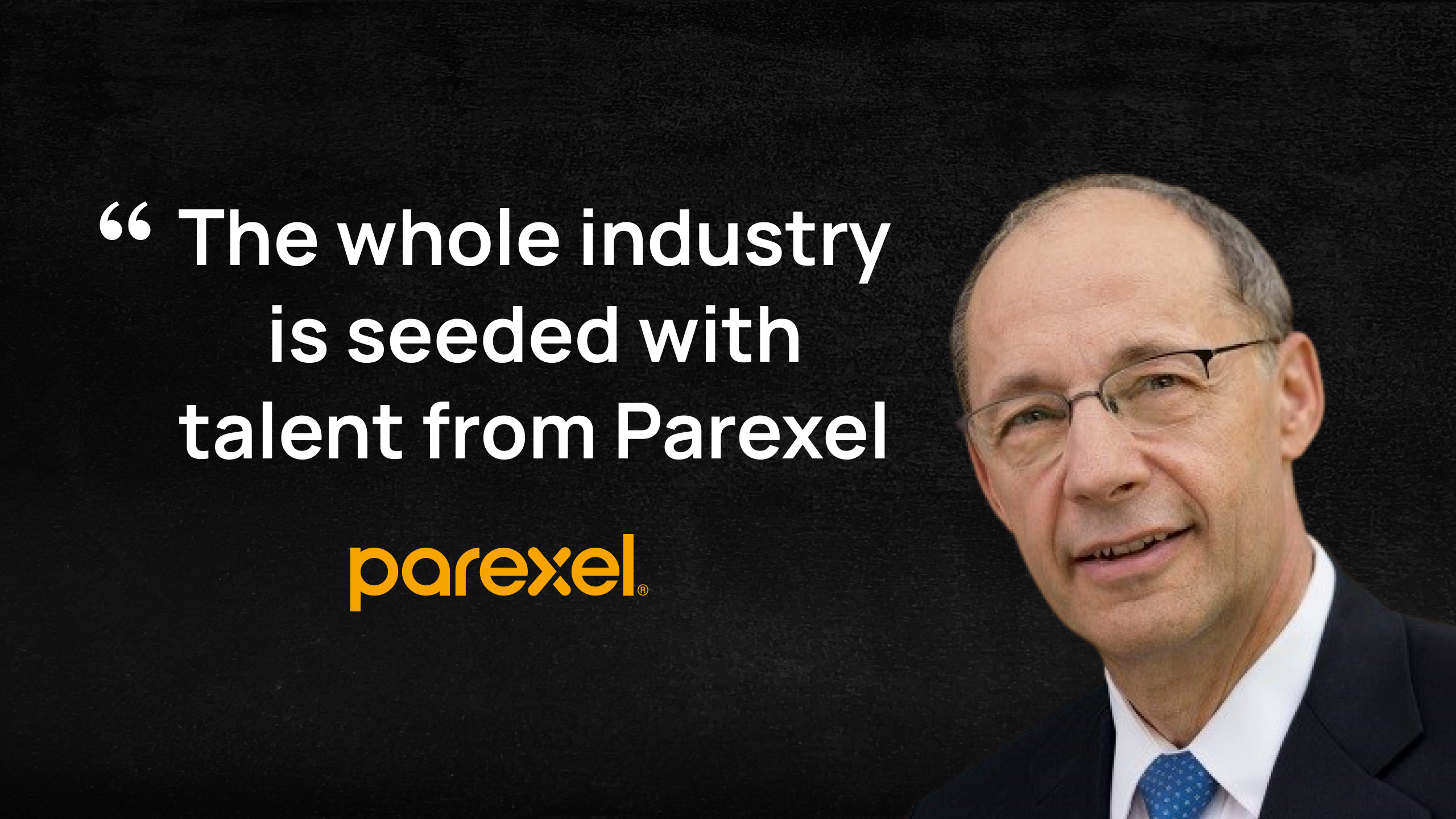
Josef von Rickenbach is a true pioneer in the pharmaceutical industry. In 1982, he co-founded Parexel, a company that would go on to define the CRO industry as we know it today. Over the next 36 years as CEO, he led over 40 acquisitions, scaled the company to 19,000 employees, and helped set industry standards that still shape biopharma today.
But Josef's story isn't just about business. It's a story of relentless execution, risk-taking, and building an entirely new industry from scratch. Convincing pharma companies to outsource clinical research - an idea that was unheard of at the time - took vision, persistence, and an ability to see patterns before others did.
In this conversation, we explore:
Guest: Josef von Rickenbach, co-founder of Parexel (with Anne Sayigh), CEO for 36 years, now senior advisor at Turner Atlantic and chairman/board member of several life sciences companies.
Host: Tomás Sabat Stöfsel, CEO & Co-Founder, Verisian
Topics: Founding Parexel and the origin of the CRO industry, raising early venture capital, the 1995 IPO after two failed attempts, restructuring through the dot-com crash, the hardest people decisions of a 36-year CEO tenure, life after Parexel, AI's likely impact on clinical research
The full episode can be found on YouTube, Apple Podcasts or Spotify.
Parexel started in 1982 not as a clinical trials company but as a regulatory advisory firm, helping small and mid-sized European and Japanese life sciences companies navigate US FDA submissions at a time when international communication still ran through telex machines and $100-for-ten-minutes phone calls. Josef von Rickenbach handled sales, financing, and operations while co-founder Anne Sayigh, a former Yale chemistry professor, handled the technical and regulatory work. The name Parexel is a nod to Paracelsus, the Swiss alchemist and early experimental physician who Josef grew up ten miles from. The pivot into running clinical trials only happened because clients kept asking who could run the US trials their new regulatory dossiers required, and at the time, commercial clinical trials happened almost exclusively inside large pharma companies themselves, so there was no one to refer them to.
Parexel became the first company to raise institutional venture capital in this space, in 1986, and that visibility revealed two other companies forming at almost the same time with the same idea: Besler Associates (founded by a Merck spinout, later became Covance) and Quintiles (founded by biostatistics professor Dennis Gillings). Together, these three companies effectively created what became known as the CRO industry, with Parexel later formally defining the category at its 1995 IPO. Joe describes the earliest venture terms as brutal by modern standards, with investors sometimes taking close to 100% of the company through "earn-in" structures the founders then had to earn back.
Parexel wrote its first S-1 for an IPO in 1993, only to have comparable company valuations drop 40% when Bill Clinton's election brought expectations of major US healthcare reform. A second attempt collapsed when underwriter Kidder Peabody went bankrupt mid-roadshow after a rogue trader lost over a billion dollars. Rival Quintiles went public first, in 1994, which Joe describes as galling after two failed attempts of his own. Parexel finally completed a successful IPO in November 1995, oversubscribed by a factor of ten, with Joe noting that going public did not feel like an endpoint: he was back at work the next morning, describing an IPO simply as "a fundraising event" and an obligation to investors rather than a milestone to savor.
After the 1995 IPO, Parexel grew rapidly to 4,000 employees by 1997 to 1998, but Joe realized the leadership team that had built the company to that point was, in his words, "maxed out" and would not scale it further. He replaced roughly 35 to 40 of the top 50 leaders, calling it the saddest day of his career specifically because he cared about the people involved. His broader leadership philosophy is that growth requires a new strategy once the current one plateaus, and at that inflection point a leader must honestly ask whether they personally are still the right person to execute it, stepping aside if not, since many companies stagnate specifically because leaders avoid that self-assessment.
Joe compares AI's likely trajectory in clinical research to the arrival of the internet: a genuine sea change, but one that historically enters this industry as a slow, cautious adoption curve rather than a sudden revolution, since every prior technology shift, including full digitization (Parexel's last paper-based trial ran as recently as 2017), followed the same gradual pattern. He is candid that the risk conversation around AI is incomplete if it only covers upside: greater ease of virtual data generation also raises the ease of fraud, which is precisely why regulators move cautiously and why audit and control mechanisms have to keep pace, given how much is at stake in trial data integrity.
"I would actually claim that the biotech industry, as we know it today, would not exist without CROs." — Josef von Rickenbach
"Success in entrepreneurship is tenacity. You have to stick with it. Everything takes longer, everything is harder than you ever thought, and costs more than you ever thought." — Josef von Rickenbach
"I always viewed myself as an athlete, and if you want to compete at the highest level, you have to be willing to do what athletes do every day." — Josef von Rickenbach
"You get to a plateau of your last strategy. It starts to peter out. Growth is not happening anymore, and you need to come with a new story." — Josef von Rickenbach
"The pharmaceutical industry still is not capitalizing on the great good that it does. I think the amount of lives that are saved... this should be the easiest story to tell on Earth." — Josef von Rickenbach
Who founded Parexel and when?
Parexel was founded in 1982 by Josef von Rickenbach and co-founder Anne Sayigh, initially as a regulatory consulting firm for European and Japanese companies seeking US market entry, before pivoting into running clinical trials directly.
How did the CRO industry get its name?
Parexel, Besler Associates (later Covance), and Quintiles were all founded independently in the early 1980s. Parexel is credited with formally defining the term "CRO" when it went public in 1995, cementing the category's identity.
When did Parexel go public, and why did it take so long?
Parexel went public in November 1995 after two earlier IPO attempts failed: one derailed by a 40% valuation drop tied to Clinton-era healthcare reform fears in 1993, and another when underwriter Kidder Peabody collapsed mid-roadshow in 1994 due to a rogue trader scandal.
What was the hardest decision Joe made as a 36-year CEO?
Replacing roughly 35 to 40 of the company's top 50 leaders shortly after the 1995 IPO, because the team that built Parexel to that point could not scale it to its next phase of growth, despite their loyalty and past contributions.
Will AI replace CROs or dramatically disrupt clinical research?
Not quickly, according to Josef von Rickenbach. He expects AI to follow the same slow adoption pattern every previous clinical research technology has followed, including full digitization, while cautioning that AI also raises the risk of data fraud, which will keep regulators cautious.
The Verisian Community Podcast brings together experts in clinical trials to exchange innovative ideas and best practices central to clinical reporting, submission and review. Aligned with Verisian's mission to accelerate the evaluation and market launch of new medical treatments, each episode features expert insights, with guests ranging from statistical programmers to medical writers, to discuss the challenges and opportunities of the latest software and technology.
You can listen to us on YouTube, Apple Podcasts or Spotify.

See Verisian in action. Share a few details and we’ll be in touch to schedule your demo.

Your request has been received. A member of the Verisian team will contact you shortly to arrange a demo.