Submit when the Science is Done
Learn how to make agentic AI trustworthy in clinical trials, with your experts in control, always.

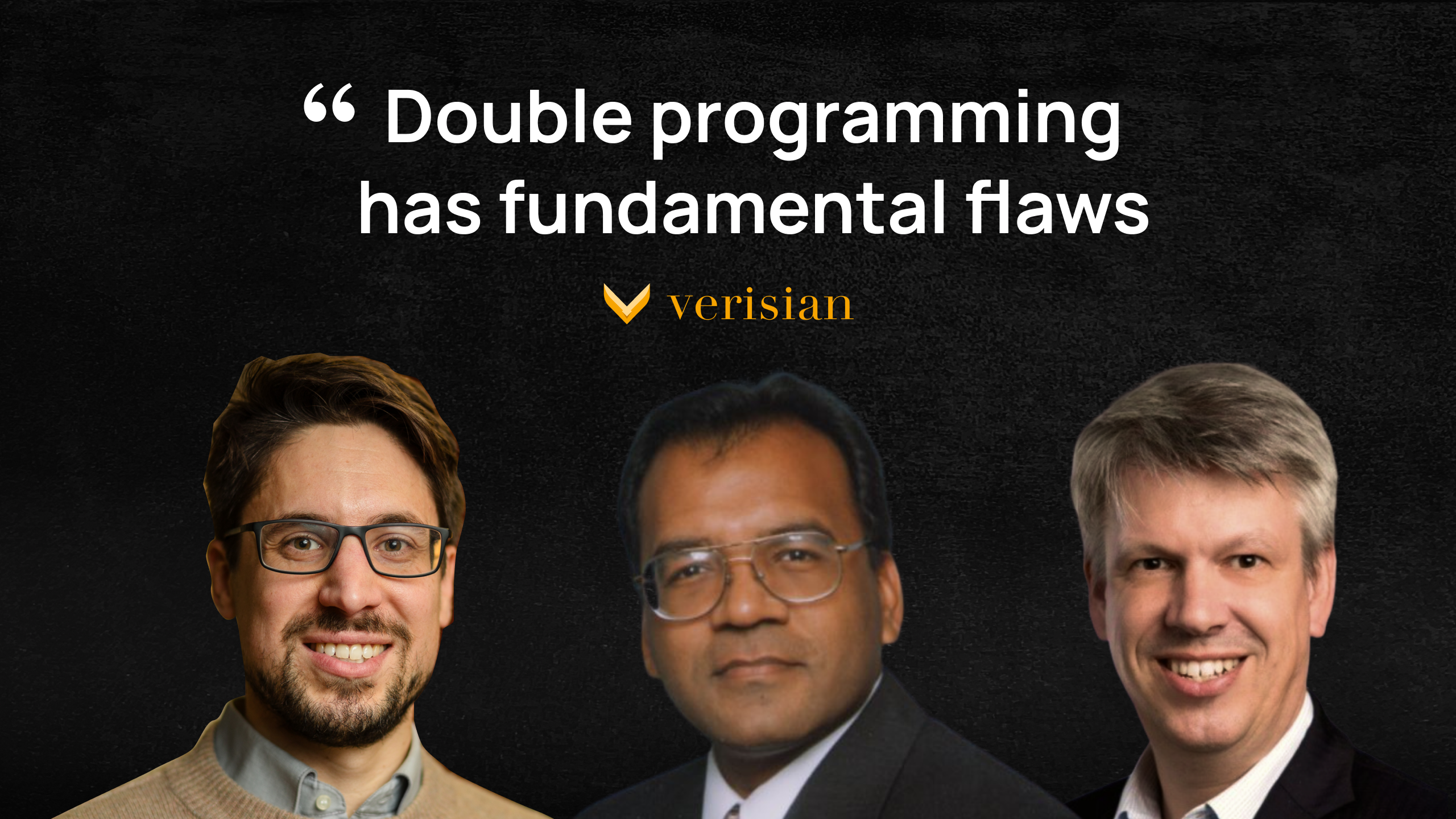
Double programming has long been the industry standard for validation in statistical programming, but is it the most effective approach? In this episode, Henning Kuich, Richardus Vonk, Sunil Gupta and Tomás Sabat Stöfsel discuss how code traceability is transforming the validation process, enhancing transparency, improving efficiency, reducing costs and enabling better collaboration across teams. The conversation explores the limitations of traditional validation methods, the potential of modern technology to streamline workflows, and the implications for the future of statistical programming. Watch now to learn about the evolution of validation and the opportunities ahead.
Guests: Henning Kuich, CTO and co-founder of Verisian; Richardus Vonk, strategic advisor to Verisian and former statistical programming leader at Bayer (28 years); Sunil Gupta, strategic advisor to Verisian, statistical programmer and industry consultant (three decades in the field).
Host: Tomás Sabat Stöfsel, CEO and Co-Founder of Verisian
Topics: Origins of code traceability at Verisian, the fundamental flaws of double programming, building trust versus validation, driving change in large pharma organizations, the SAS-to-R transition as an adoption case study, a walkthrough of Verisian's Explorer and Validator modules
The full episode can be found on YouTube, Apple Podcasts or Spotify.
Henning argues that double programming, two people independently writing code and comparing results, has a fundamental logical flaw: it assumes that if two independently produced outputs match, the result must be correct. But two programmers can make the same misunderstanding of a specification or the same logical mistake, meaning agreement does not equal correctness. He contrasts this with software engineering's pull-request review model, where developers work collaboratively and iteratively with visibility into each other's reasoning rather than in isolation. Richardus adds a regulatory practitioner's view: after 28 years at Bayer, he sees double programming as a very expensive, still-inadequate solution to a deeper problem, since even a fully double-programmed analysis frequently breaks when the database closes and unanticipated data issues surface, forcing the whole process to run again.
Richardus reframes the industry's real goal as building trust in results, not executing a validation process for its own sake, arguing that regulators and sponsors ultimately need confidence that a drug works and is safe, not proof that a specific procedure was followed. Henning extends this into what he calls a focus on truth over validation: "just because you do double programming doesn't make anything valid, two things that are wrong are still wrong." Both agree that Verisian's code traceability approach, linking raw data, code, and outputs into one visual, reviewable chain, offers a more direct path to that trust than two people independently reproducing the same numbers.
Henning walks through the platform's two core modules. The Explorer lets a programmer click on any variable in an SDTM or ADaM dataset and immediately see the exact lines of code responsible for deriving it, filtered down from potentially thousands of lines across multiple files and macros to only the ones that matter, alongside the raw data, the derived data, and the final table, listing, or figure output. The Validator applies the same underlying traceability to a structured review process: specification validation confirms each variable is implemented as specified, results validation confirms each output is correct, and any problems found are logged as issues tied directly to the exact point in the code and data where the reviewer found them, rather than as a disconnected note. Henning cites one early example where a compliance-check review that used to take an extended session collapsed into a single hour once the team could see the underlying code and data alongside each flagged message.
Discussing why proven-better tools often struggle to get adopted inside large pharma organizations, Richardus shares a framework from a former manager: the "FBI principle," facts, benefits, incentives. It is not enough to state a tool's technical facts; you have to show the tangible benefit (faster, cheaper) and the personal incentive (what the person gets to do with the time saved), and specifically address the underlying fear that change represents a threat, whether to a person's job, their trial's specialness, or their reputation. Sunil draws a parallel to his own resistance, and eventual adoption, of R over SAS after decades as a SAS specialist: exposure and low-effort entry points, not wholesale migration mandates, were what shifted his thinking, alongside listening to peers who had already made the transition and asking them directly why.
Tomás raises a pointed question: does eliminating double programming threaten CROs whose business model partly rests on billing for it? Richardus responds that double programming is fundamentally a cost that gets passed on to clients regardless, and that CROs' real value lies in domain expertise, not in hours billed for a specific QC method. Henning, drawing on his own experience pushing new tools through a large pharma organization at Bayer, argues that big companies are hard to move but enormously powerful once moved, and that introducing genuinely transformative change, not just marginal improvement, is precisely the kind of bet that builds a career, provided the barrier to first trying the new approach is kept deliberately low.
"Double programming is really old school. We don't need to continue using training wheels to ride our bicycle, that's what we're doing with double programming." — Sunil Gupta
"Double programming just has fundamental flaws, that it is really a process that forces people to work separately from one another." — Henning Kuich
"We're using the word validation, but just because you do double programming doesn't make anything valid. Two things that are wrong are still wrong." — Henning Kuich
"So this is why I think that we should rethink the whole concept of building trust rather than validation." — Richardus Vonk
"There's an opportunity in being early, and there's a risk in being late in these things." — Henning Kuich
Will double programming still be the gold standard for statistical programming validation in 10 years?
No, according to all four speakers on this episode, including two independent strategic advisors with a combined six decades of pharma industry experience, who each answered "no" on record when asked directly.
Why is double programming considered flawed if two programmers reach the same result?
Because agreement between two independently produced outputs does not guarantee correctness; both programmers can misunderstand the same specification or make the same logical error, and the process itself forces isolated rather than collaborative work.
What is code traceability, and how is it different from double programming?
Code traceability links raw data, the code that transforms it, and the resulting output into one reviewable, visual chain, so a reviewer can filter directly to the lines of code relevant to a specific variable rather than manually re-deriving results through a second, independent program.
How much time can code traceability save on validation reviews?
Early users reported time savings of around 95% on complex derivations in phase two trials, with one compliance-check review that previously took much longer collapsing into a single hour once code and data were reviewed together.
Why do good tools struggle to get adopted in large pharma organizations?
Because resistance to change is often driven less by the tool's quality and more by personal risk, reputational stakes, and the sense of a threat to established ways of working, which is why explicitly framing facts, benefits, and incentives, and lowering the effort required to try something new, matters as much as the technology itself.
The Verisian Community Podcast brings together experts in clinical trials to exchange innovative ideas and best practices central to clinical reporting, submission and review. Aligned with Verisian's mission to accelerate the evaluation and market launch of new medical treatments, each episode features expert insights, with guests ranging from statistical programmers to medical writers, to discuss the challenges and opportunities of the latest software and technology.
You can listen to us on YouTube, Apple Podcasts or Spotify.

See Verisian in action. Share a few details and we’ll be in touch to schedule your demo.

Your request has been received. A member of the Verisian team will contact you shortly to arrange a demo.