Submit when the Science is Done
Learn how to make agentic AI trustworthy in clinical trials, with your experts in control, always.

Yesterday, CDISC hosted the public release webinar for CDISC Open Rules and the CDISC Open Rules Engine (CORE) v1.0. I presented the engine overview on behalf of the CORE team at Verisian, which has been working with CDISC to get v1.0 ready. Here are the key points.
CORE is a free, open-source validation engine that checks your data against CDISC standards using CDISC's published Open Rules. You give it your datasets, it runs every rule, and it produces a single, shareable Excel report of every violation. You don't need programming skills, and it runs entirely on your own machine, so your data never leaves it.
There are two engine repositories: The CDISC engine, for TIG, USDM and SEND, and the Verisian SQL engine, for SDTM and FDA Business Rules. This post covers the Verisian engine.
ADaM and Define-XML rules are in development. About 80% of the ADaM rules are already written.
The original engine used pandas, which loads every dataset into memory, so memory use and run time grew quickly with study size. We rebuilt it on PostgreSQL: the data is loaded once and each rule runs as a single optimised database query. In practice, bigger studies run faster on the same laptop.
All you need is Python 3.12. The release includes the latest rules, so there's nothing else to set up:
git clone --branch v1.0.0 https://github.com/verisianHQ/cdisc-rules-engine
cd cdisc-rules-engine
python3.12 -m venv venv
source ./venv/bin/activate
python -m pip install -r requirements.txt
python core.py validate -s sdtmig -v 3-4 -d path/to/datasets
Optional flags let you add your Define-XML, run or exclude specific rules, supply licensed MedDRA/WHODrug files, or output JSON or CSV for pipelines. See the README for the full list.
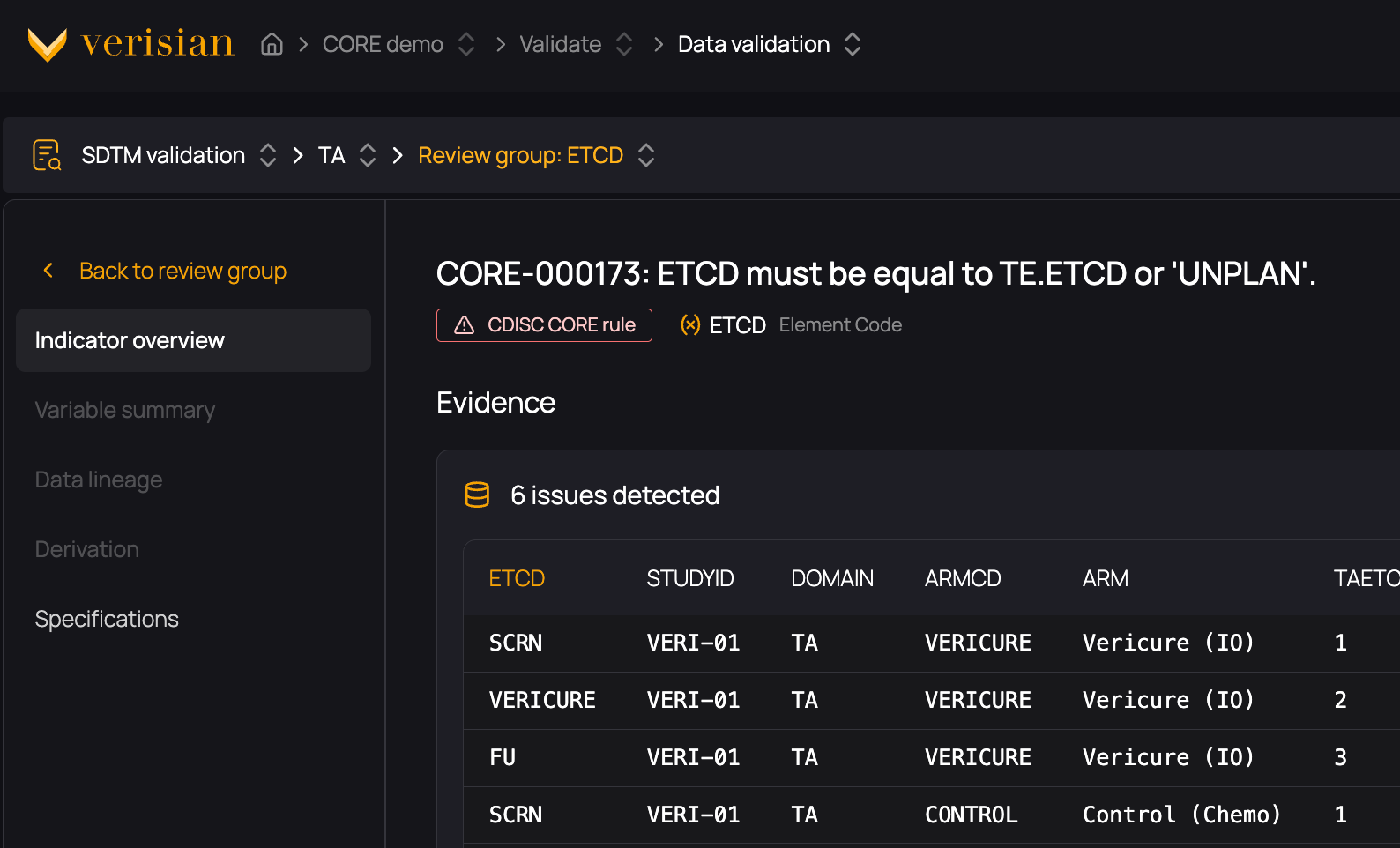
In the report, start with the Issue Summary to understand each type of violation, then drill into specific rows in Issue Details. The Rules Report gives every rule a status (ISSUE REPORTED, SUCCESS, SKIPPED or EXECUTION ERROR), with a reason for any rule that was skipped or failed.

We've tested extensively, but real-world use can find what testing can't. One user recently ran an unexpectedly large FA dataset that exposed an inefficient rule. We've fixed it, and the fix will ship shortly as v1.0.1. Please raise anything that looks off on GitHub.
Try CORE, share it with colleagues and tell us how it goes. To help write and review the ADaM and Define-XML rules and get v2 out faster, volunteer at cdisc.org/volunteer.
The Verisian platform runs CORE as part of the Validated by Verisian process. Along with the report, the platform offers much more - every CORE finding comes with the exact trace to the code and data that produced it Issues can be fixed as they arise during development, so studies stay continuously validated and submission-ready, with submission documents generated from the same study. While the open-source engine is designed for submissions up to about 1.5 GB, the Verisian platform is fully managed with no limit on study size, so we take care of the infrastructure, security and version upgrades. Please get in touch if you’d like a demo.

See Verisian in action. Share a few details and we’ll be in touch to schedule your demo.

Your request has been received. A member of the Verisian team will contact you shortly to arrange a demo.
